Guide · ready-to-copy prompts
What to study in 2027 before AI beats you.
The study path I'd follow in data, AI and machine learning, and cybersecurity, with the sourced numbers behind each one, free courses in order and a portfolio project for each. Full guide to read here; the PDF and the prompt download with your free account.
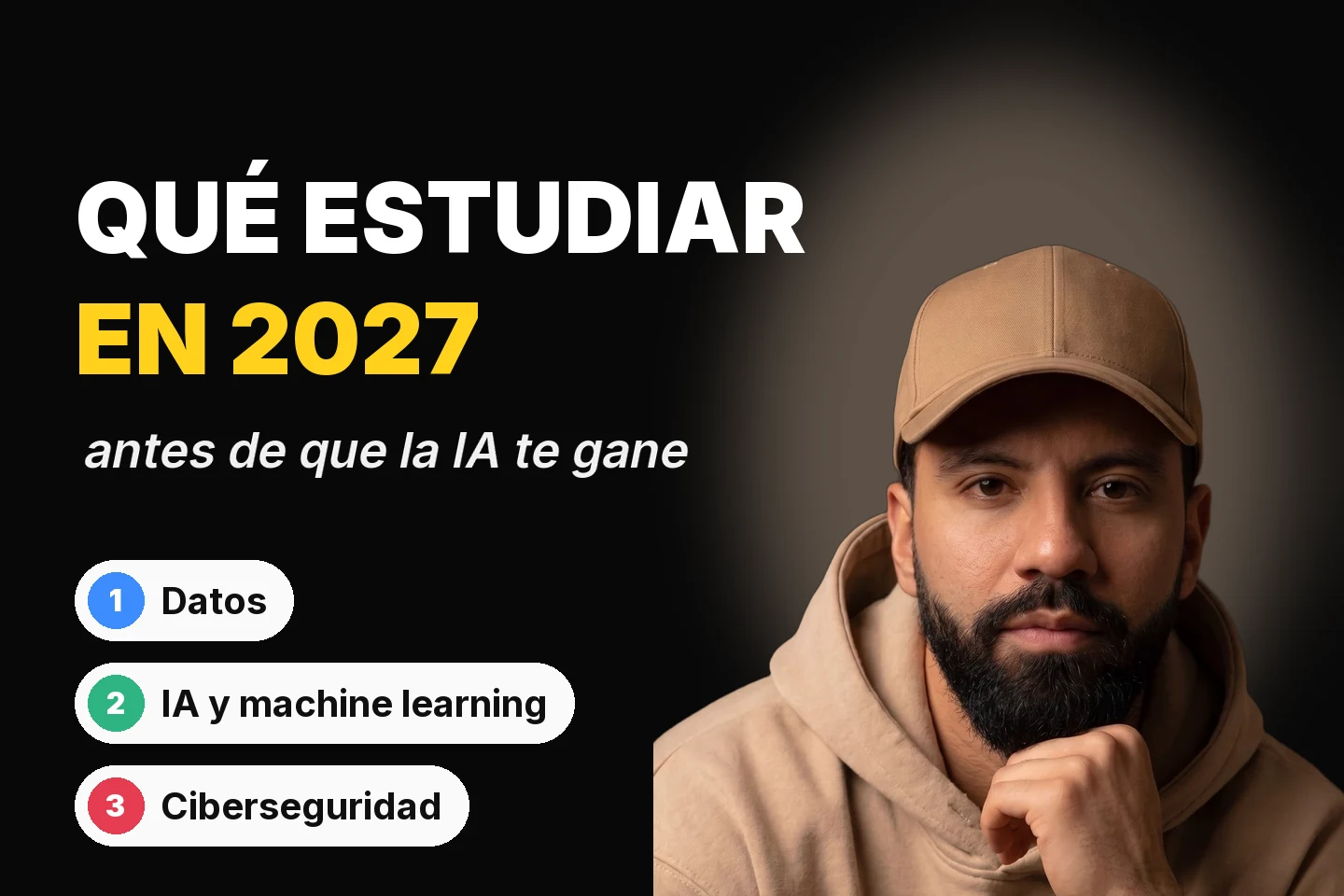
Are you going to study tech and worried AI will do your job before you graduate? This is the path I'd follow in 2027 for the three careers with the most future: data, AI and machine learning, and cybersecurity. For each one you get why it's worth it (with the source), free courses in order and a portfolio project.
1Why these three
| Career | The number | Source |
|---|---|---|
| Data (big data) | Big data specialists are the fastest-growing job through 2030 | World Economic Forum, Future of Jobs Report 2025 |
| AI and machine learning | 86% of employers expect AI to transform their business by 2030 | World Economic Forum, Future of Jobs Report 2025 |
| Cybersecurity | Information security analysts will grow 21% from 2025 to 2035, six times the average for all jobs (3.5%) | U.S. Bureau of Labor Statistics, projections published August 27, 2026 |
What almost nobody tells you: a Stanford study found that employment of 22–25-year-olds in the jobs most exposed to AI is 19% below where it would be had it kept pace with their less-exposed peers. Experienced workers show no comparable gap. AI already does the basics, so more is being asked of junior profiles.
Read the Stanford study2What they ask for now (all three)
- Real projects that solve a problem, published on GitHub.
- Using AI as a tool: to help you code, review and document, not to think for you.
- Solid theory: statistics, networks, databases. What AI can't explain if you don't know what to ask.
- English, no excuses: docs, courses and the best-paid jobs are in English.
3Path 1. Data
- Python and pandas on Kaggle Learn, free certificate. kaggle.com/learn/pandas
- SQL on Kaggle Learn. kaggle.com/learn/intro-to-sql
- Data Analysis with Python by freeCodeCamp, free certification. freecodecamp.org/learn/data-analysis-with-python
- Data engineering: DataTalksClub's Data Engineering Zoomcamp. github.com/DataTalksClub/data-engineering-zoomcamp
Portfolio project: a pipeline that downloads an open dataset from your country every week, cleans it with Python, stores it in a database and shows it on a dashboard with 3 conclusions written by you.
4Path 2. AI and machine learning
- Intro to Machine Learning on Kaggle Learn. kaggle.com/learn/intro-to-machine-learning
- Google's Machine Learning Crash Course. developers.google.com/machine-learning/crash-course
- fast.ai Practical Deep Learning for Coders. course.fast.ai
- Hugging Face AI Agents Course. huggingface.co/learn/agents-course
- Anthropic courses to work with Claude and its API. anthropic.skilljar.com
Portfolio project: an agent that answers questions about real documents and cites the page each answer came from, with a page where anyone can try it.
5Path 3. Cybersecurity
- Introduction to Cybersecurity by Cisco Networking Academy (free). netacad.com/courses/introduction-to-cybersecurity
- Cisco Networking Basics. netacad.com/courses/networking-basics
- OverTheWire: Bandit, learn the Linux terminal by playing. overthewire.org/wargames/bandit
- picoCTF, free security challenges from Carnegie Mellon. picoctf.org
Portfolio project: a lab on your computer with two virtual machines (one attacker and one intentionally vulnerable) and a written report of how you found each flaw and how you'd fix it. Only practice on systems you own or platforms built for it.
6Prompt for Claude to build your plan
I want to study [data / AI and machine learning / cybersecurity] in 2027. I have [X] hours a week and my level is [beginner / intermediate].
1. Build a 12-week plan with the free courses from this list: [paste the path].
2. For each week tell me what to study, what to practice and how I'll know I understood it.
3. In week 8 start the portfolio project and split it into small tasks.
4. Don't give me the solutions: ask me questions so I get there myself.7Sources
- World Economic Forum, *Future of Jobs Report 2025* (January 2025).
- U.S. Bureau of Labor Statistics, *Occupational Outlook Handbook: Information Security Analysts* and *Employment Projections 2025–35* (August 2026).
- Brynjolfsson, Chandar and Chen, *Canaries in the Coal Mine?*, Stanford Digital Economy Lab (revised August 12, 2026).
Optional download
Want to keep it?.
You already read the full guide, no account needed. If you want the files on your computer, create your free account: it takes less than a minute.
- ruta-estudio-2027-guia.pdf2.2 MB
- prompt-ruta-estudio.md1 KB
Your free account also gives you
- Downloads on every resource. The files of every guide, today's and the ones still to come, without asking again.
- Free courses. Learn step by step with video lessons and track your progress.
- Spanish-speaking community. Ask, share what you build and get answers from others who use AI like you.
- Live events. We let you know before each one so you don't miss it.
- Member card, points and ranking. Earn points for joining in and learning, and climb the ranking.
Already have an account? Log in
Andrés Gómez
Practical AI to create content, photos and brand. @andresgomez.ia
Keep going with